The cedars near where he made his camp were unlike the rest of the forest.
He had noticed it on the first morning without understanding why it unsettled him. The trees on Mount Tenmoku, where his army had finally come apart, grew thin and grey-barked, fighting for soil between exposed granite. Here, a half-day's walk further in, the cedars grew wider. Older, their bark a deep mossy green that held its colour even in shadow. The undergrowth was thick and lush for the season, ferns and moss in a green so saturated it looked wet even when it wasn't. He thought of the ancient cedar groves spoken of on Yakushima5, sacred and impossibly old, though no one he knew had ever travelled far enough south to see them.
It should not have been this green. It was barely spring, and the cold at night was the kind that got into the joints and stayed there.
He built his hut at the base of one of the largest trees, using what skills a lord's son acquires by accident from watching retainers and servants and never expecting to need the knowledge himself. Branches lashed with vine. A floor of packed bracken to keep the damp from climbing into his bones while he slept. It was not shelter befitting a Takeda but one befitting a man who no longer had a name worth defending, which suited him better than he expected it to.
Nobu had broken her leg three days before, on the descent through the worst of the Shinano passes. Her hoof caught a wet stone in the dark. He remembered the sound of it more clearly than almost anything else from the retreat. A single sharp crack, swallowed almost immediately by the rain, and the horse going down into the mud without a sound.
He had ridden her since she was a yearling. His father had named her before that, when she was still a foal in the Takeda stables. Nobu 信. Loyalty. The kind of name a man gives an animal when he intends to keep faith with it for as long as they both live.
She had not deserved to break it here, in a forest with no name.
He did not have it in him to do what should have been done immediately.
A horse with a shattered leg does not recover. Every groom who had ever served his family had told him this in one form or another, the practical wisdom of men who understood horses as tools first and companions only by incidental affection. The honourable and efficient thing was a quick blade and an end to suffering.
He could not make himself do it.
Instead, he built a fire close enough to warm her without smoking her eyes and lay down beside her in the bracken with his arm across her neck, the way he had not done since he was a boy too young to understand that a lord does not embrace his horse in front of retainers.
There were no retainers now.
There was no one left to perform dignity for.
"I'm sorry," he told her, which was a strange thing to say to an animal, and stranger still that it felt necessary regardless.
She breathed unevenly through the night. He felt it through his arm, the rhythm growing shallower as the cold deepened. He had already watched too many things die to expect good news in the morning. He stayed awake as long as he could so she would not be alone for whatever remained of it.
At some point exhaustion took him anyway.
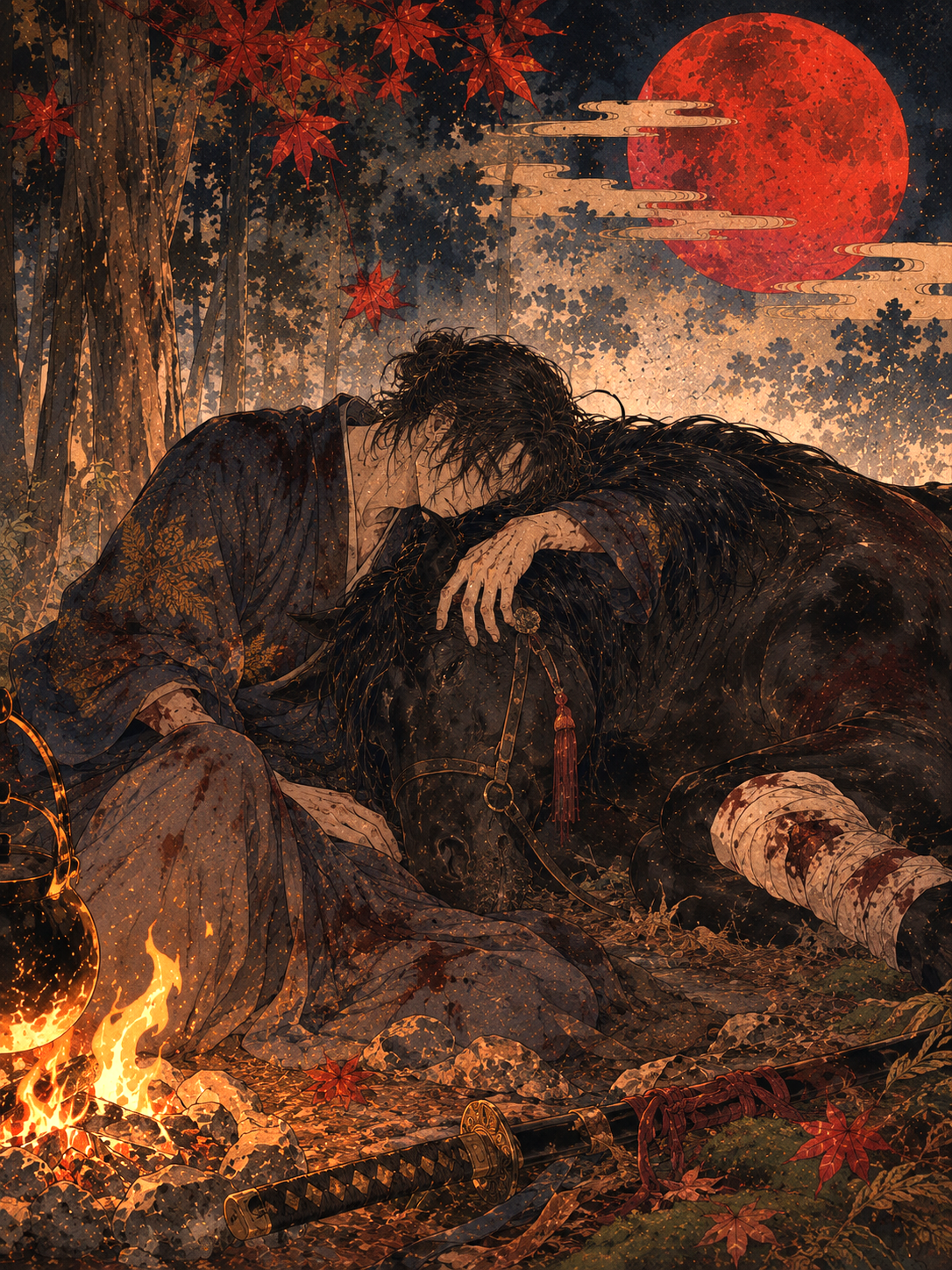
When he woke, the fire had burned to embers and Nobu was gone.
He stared at the flattened bracken where she should have been. Hunger and exhaustion did this. He had heard of starving men in the mountains seeing whole banquets laid before them, whole villages that did not exist. He pressed his palm against the ground where her body had lain and found it still faintly warm. It told him nothing except that he could no longer trust his own senses to report the world accurately.
A dead horse does not walk away. Either she had died and something had taken her, which seemed unlikely given how quiet the night had been, or she had not died at all, which was impossible given the wound. Neither answer satisfied the part of his mind still operating on the old laws of the world he had lost.
He went looking for water, because looking for water was a thing a sane man did.
He found the waterfall by its sound before he saw it. A steady collapse of water over black stone, falling into a pool clear enough to see straight to its pale floor, ringed by the same lush undergrowth that had unsettled him since he first walked into this part of the forest. The cold mountain air carried the smell of moss and cold spray.
And there, on the far bank, was Nobu.
Not dying. Not even injured. She stood with her full weight evenly distributed across all four legs, her coat dark and glossy in a way it had not been even before the injury. Black as wet lacquer, catching the early light along her flank.
She was being ridden, slowly, along the riverbank, by the girl from the cedar grove.
The yukata. The antlers. He would have known her from any distance.
She saw him and called out across the water without any of the formality the moment seemed to require.
"Ya-ho! Is this your horse?"
He stood very still.
"Yes," he said, before he had decided to answer at all.
"I like her," the girl said, patting Nobu's neck with evident satisfaction. "Can I keep her?"
"Is this hell?" Katsuyori asked, because it seemed like a reasonable question under the circumstances. "Am I dead?"
The girl made a face. "Neither. Are you stupid or what?"
She nudged Nobu forward, walking her along the bank and then through the shallow water at the base of the falls, the horse's hooves finding the stones with the confidence of an animal who had never broken anything in her life.
"She had a broken leg," the girl said, as though continuing a conversation rather than starting one. "Not dying. So I fixed it."
Katsuyori felt something in his understanding of the world quietly come apart. "Horses with broken legs don't recover," he said. "Not from a break like that."
"Not to you, maybe." She shrugged, entirely unbothered by his disbelief. "The name's Shika. Hey, unc—what's yours?"
It was the first time in longer than he could measure that something close to laughter rose in him unbidden.
"I'm not an uncle," he said. "My name is Katsuyori." He paused. "Shika. Your name literally means deer."
"Katsuyori mo shika," she chuckled immediately, delighted with herself, the pun landing before he'd fully processed the first half of the sentence.
I like deer more than fried cutlet.
カツよりも鹿
She grinned at him as though she had been waiting her entire life—however long that was—for someone to hand her the right name to play with.
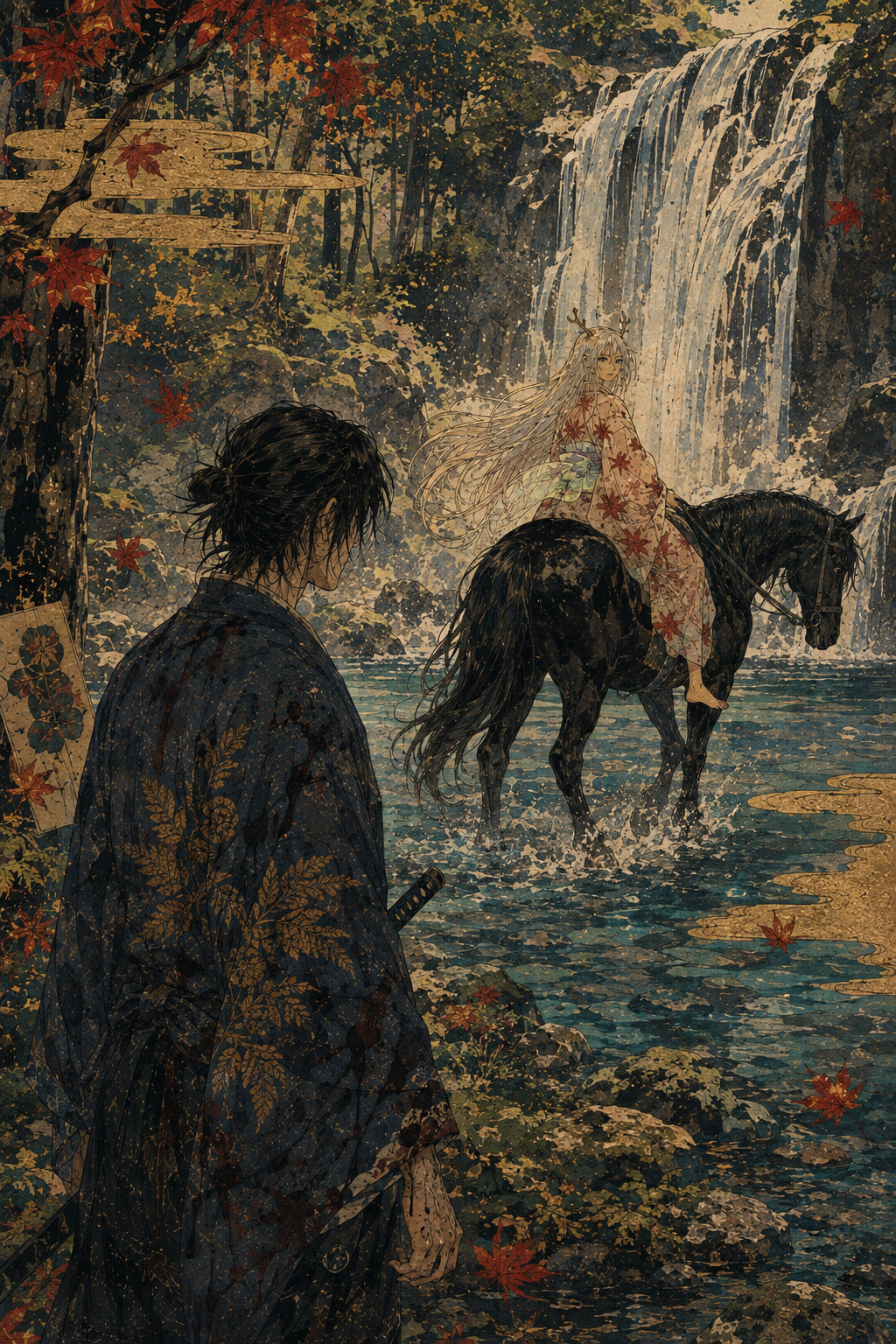
He stared at her. The disbelief must have shown plainly on his face, because she rolled her eyes, slid down from Nobu's back with no particular ceremony, and crossed the remaining distance between them.
Then she punched him in the stomach.
Not hard enough to wind him. Hard enough to be unmistakably real.
"There ya go, dum-dum," she said. "You're not dreaming. Proof."
She did not look very tall once she was standing. Pint-sized, even, barely reaching his shoulder. Up close she was something he did not have a category for. Almond-shaped eyes, dark and amused, set in a face that should not have belonged to the hair above it—full, falling well past her waist, catching the early light with a shine that looked less like colour and more like something borrowed from centuries of sun. Her lips held a permanent slight pout, unbothered and faintly amused, as if trouble had given up trying to reach her.
The yukata was thin—too thin for the season, patterned in fading red maple leaves, and the spring cold should have had her shivering in it. She did not so much as shiver. The fabric was worn near-transparent in places, the silhouette of her beneath it visible when she moved against the light, and he made himself look away from that, the old reflexive courtesy of a man raised in a house with strict rules about where a gaze was permitted to rest.
The obi at her waist was the strangest thing about her, which was a considerable claim given the antlers. In the shade beneath the cedars, it had glowed faintly, a low colour he couldn't name. Here in direct sun near the falls, it had gone nearly transparent, and through it he could see the green of the moss behind her, as though the fabric borrowed its colour from whatever stood behind it rather than holding any of its own.
"Want some grass?" she asked, completely serious, looking him over the way one looks over livestock. "You look hungry."
He laughed. Twice now in the space of a few minutes, more than in the whole retreat from Nagashino. "That would be generous of you. Though I would also be grateful for fish, if you happen to know where the good ones are."
"Oh, fish." She tilted her head, considering it with the gravity of a much larger decision. "You wanna hunt 'em or rob 'em?"
He laughed a third time before he could stop himself. The sound was foreign in his own throat.
"Come on," she said, already turning, Nobu falling into step behind her without being led, the horse's new black coat gleaming where the falls' spray caught it. "There's a bend past the rocks. Slow water. Even you could catch something there."
He followed her along the bank, past where the falls broke into a wide shallow pool, the lushness of the moss giving way to flat stones polished smooth by centuries of water. She walked ahead of him with no particular care for the cold or the uneven ground, bare feet finding their way across wet rock with an ease that belonged to someone that had walked this exact path more times than could be counted.
He watched her go, the obi shifting colour with every step in and out of shadow, the hair swinging loose against her back. He understood, with the same clarity that had told him morning would not bring good news for Nobu, that he no longer had any reliable way of predicting what came next.
It did not feel like hell.
It did not, strangely, feel like hallucinated grief either.
Author’s note:
5. Yakushima island is home to primeval forests featuring cedar trees that are over 1,000 years old (known as yakusugi). The most famous, the Jomon Sugi, is estimated to be anywhere from 2,300 to 7,000 years old. In Shinto, such extraordinarily old trees are considered sacred and house powerful spirits. Shinto priests view Yakushima as a sacred landing place. It is believed to be the earthly location where the gods first touch down before making their way to their respective shrines across Japan.
6. Katsuyori mo shika (カツよりも鹿) directly translates to I like deer more than fried food. It's a Japanese pun that sounds similar to 勝頼も鹿 ("Katsuyori and deer"), playing on the character's name, 勝頼 (Katsuyori), and カツ (katsu, fried cutlet).
Comments
No comments yet. Be the first to share your thoughts!