The Battle of Nagashino (1) had not gone the way the old generals promised.
Katsuyori remembered the morning of it with clarity. The mist still clinging to the Shitaragahara plain, the banners of the Takeda cavalry rising and falling in the grey light, the sound of fifteen thousand men breathing in unison before the order came. His father's cavalry had broken every army it had ever faced. He had believed, with the conviction of a son standing in a father's shadow, that it would break this one too.
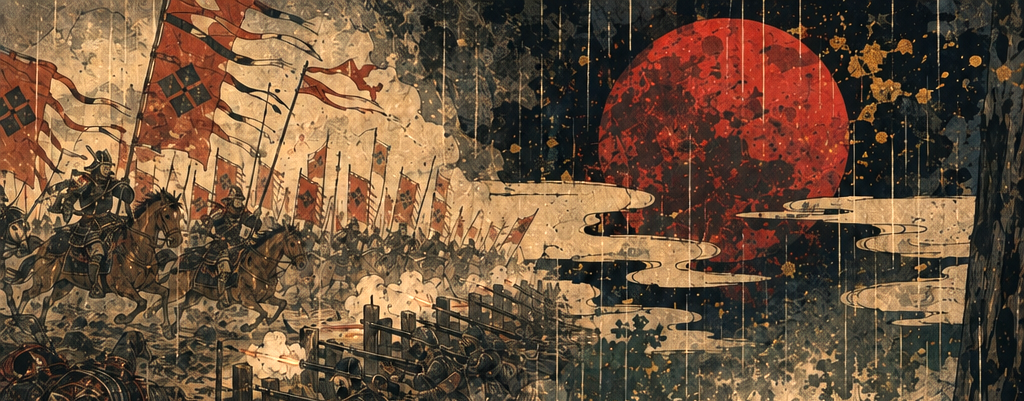
He had not accounted for the wooden palisades.
Oda Nobunaga had built them in three rows, low fences staked into the mud behind the Rengogawa river. Behind them he had placed three thousand arquebusiers in rotating ranks. Fire, fall back, reload, fire again, a rhythm that never broke and did not care how many times the Takeda cavalry charged into it. Katsuyori watched from the rear as wave after wave of his finest horsemen rode into that rhythm and did not ride back out.
Yamagata Masakage (2) fell. Baba Nobufusa fell. Naitō Masatoyo fell. The names of his father's most trusted generals, men who had carried the Takeda banner since before Katsuyori was old enough to hold a sword, disappeared into the gunsmoke one after another, and the smoke did not clear quickly enough to let him see them go.
By afternoon the plain was a field of his own dead.
He retreated with what remained—a fraction of the army that had marched out three days before, men whose faces he had known since boyhood now hollowed out. They moved through the mountains of Shinano in stages, losing more at every stage, the way armies do once they have learned which way history is pointing. By the time they reached Tenmokuzan (3), there were almost none left to defect.
His wife had already taken her own life rather than be captured. His sons were dead beside her. The retainers who remained had each, in their own time and in their own way, chosen their ending in the manner the age required, and Katsuyori had stood witness to each one, nodding at the correct moments, saying the appropriate words, feeling less present in his own body with every name added to the list.
He walked the last distance alone.
The forest near Tano took him in without ceremony. Cedars old enough to have outlasted several lifetimes of men exactly like him. Rain falling steadily through the high canopy. He had nothing left to defend and no one left to command. The crest that had once made castle gates open meant nothing to the trees, which had seen other crests and other lords and other rainy spring evenings exactly like this one, and would see others after him.
He knelt beneath them, soaked to the bone, and understood that the story had reached the place every story like his reached eventually.
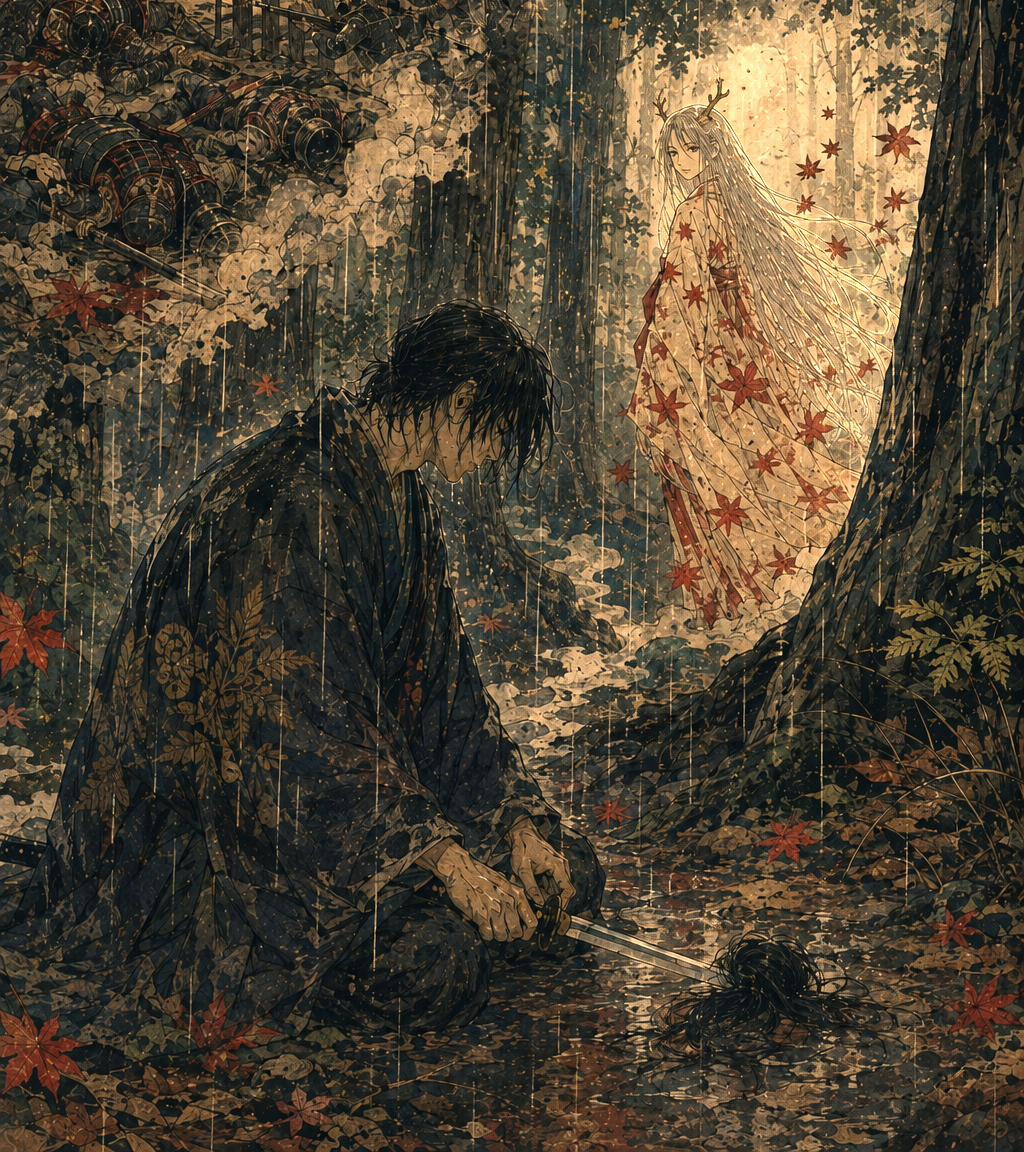
For a long time, he stayed there in the rain with the dagger resting in his hands. The steel reflected a face he no longer recognised. Not a warlord. Not a Takeda lord. Simply a man stripped of the names that had defined him. His hands trembled as the truth finally surfaced within him, not as courage or conviction but as something far more humiliating.
"I don't want to die."
He lowered his head. No battlefield confession had ever been so complete in its dishonour.
There was no glory left in him. No revenge. No honour. Only the simple and unbearable desire to continue existing.
Even now.
Even after everything.
His fingers moved to the topknot at the back of his head, the symbol of what he had been and what he was expected to remain (4). The blade flashed once and his hair fell into the mud. The rain carried it away without interest, as though even the forest refused to acknowledge what he had just discarded.
He stared at the severed knot for a long time. Then he laughed, a broken sound without joy, the kind of laughter that belongs to men who have already died and forgotten to fall.
That was when he saw her.
At first, he thought it was a hallucination brought on by exhaustion or hunger. A girl stood between the trees where no one should have been. Autumn leaves drifted around her despite it being spring, circling her as though the season itself had become uncertain. She wore a faded yukata patterned like red maple leaves. Her hair reached her waist, luminous like the heart of a pearl. Though her skin was olive and freckled, her features were unmistakably Yayoi, shaped by the land rather than foreignness.
There was nothing refined about her presence. It was wild, almost untamed, as though she belonged more to the forest than to the world of men. Small deer antlers rose from her head, neither threatening nor explaining themselves.
She watched him openly, without fear or caution, only curiosity, like a deer observing something it could not decide whether to approach or avoid.
Katsuyori blinked.
When he looked again, she was gone.
Only the drifting leaves remained where she had stood.
He exhaled slowly.
"Hallucination."
And for the first time since Nagashino, he allowed himself to believe the forest might be lying to him.
Author’s note:
1. The Battle of Nagashino and Shitaragahara (長篠・設楽原の戦い) (1575) was one of the defining engagements of Japan's Sengoku period. Fought in present-day Aichi Prefecture, the combined forces of Oda Nobunaga and Tokugawa Ieyasu decisively defeated Takeda Katsuyori's army. Historians often regard the battle as a major turning point in Japanese military history, as Nobunaga's extensive use of rotating ranks of tanegashima (matchlock firearms introduced to Japan by the Portuguese in the 16th century) proved devastating against the famed Takeda cavalry. The victory significantly weakened the Takeda clan and strengthened Nobunaga's path towards the unification of Japan.
2. Among those who fought under Katsuyori were Yamagata Masakage, Baba Nobufusa, and Naitō Masatoyo, celebrated retainers traditionally counted among the Twenty-Four Generals of Takeda Shingen. Their loyalty and military achievements became the subject of numerous historical accounts and later legends.
3. The Battle of Tenmokuzan (天目山の戦い) is regarded as the last stand of the Takeda clan.
4. The topknot or chonmage (丁髷) is a type of traditional Japanese topknot haircut worn by men in feudal Japan. During the Sengoku period, a samurai's topknot was far more than a hairstyle—it was a visible symbol of his rank, identity, and honour. To sever it by one's own hand was to abandon not only one's status, but the life that came with it.
1 Comment
Whoa.... This is insane! Katsuyori thoughts and feelings were very well depicted! I am excited for chapter 2